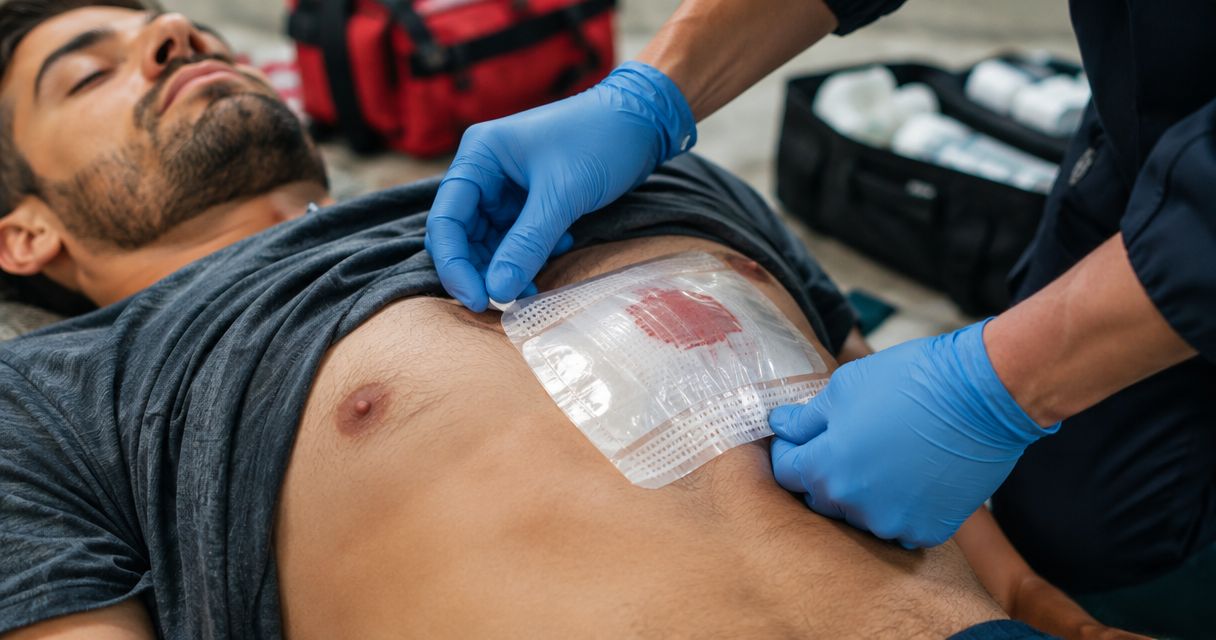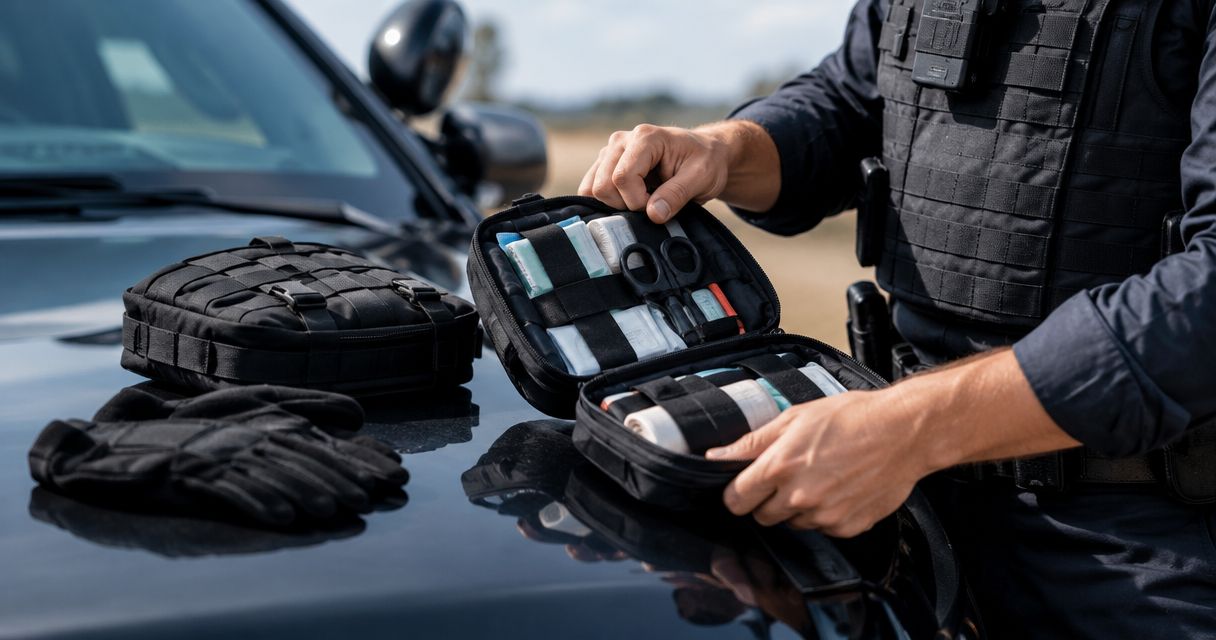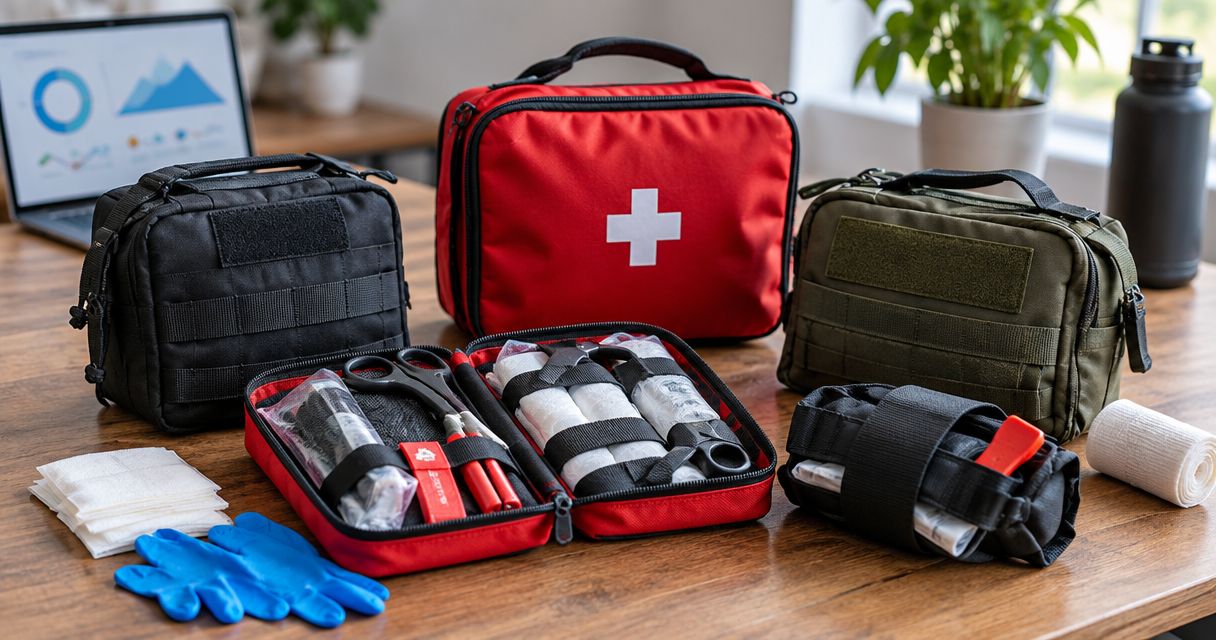
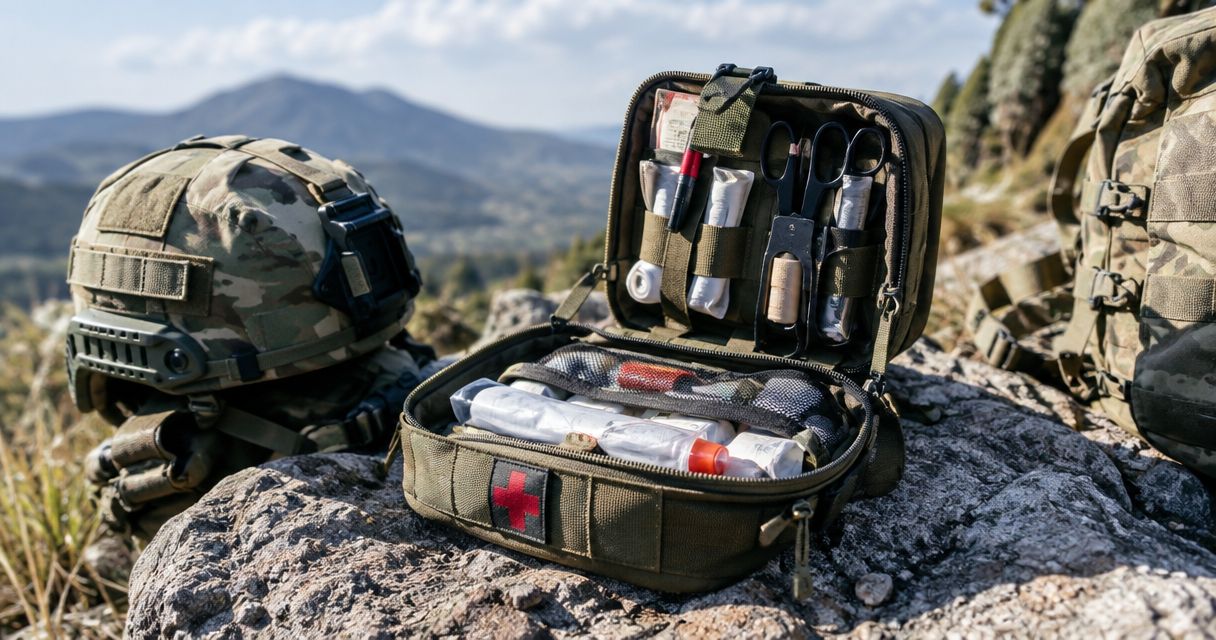
Picking the best IFAK kit for military use in 2026 comes down to matching components to a role, not grabbing the biggest pouch on the shelf. A rifleman, a designated medic, a vehicle crew, and a K9 handler all need different configurations, even though every one of them is built around the same core mission: stop massive hemorrhage fast. This guide ranks six IFAK configurations against the criteria North American Rescue uses to evaluate tactical medical loadouts, so you can match the kit to the mission instead of forcing one kit to cover every job.
- The best IFAK kit for military use in 2026 is the Individual First Aid Kit (Gen 3-style) for on-body carry by individual soldiers and Marines.
- Medics and corpsmen need an Advanced Medic-Level IFAK with expanded hemostatic gauze and airway adjuncts, not the individual kit.
- Verify every C-A-T Tourniquet is genuine before it goes in a military IFAK — counterfeit units have no place in a bleeding control kit.
- Vehicle crews, K9 handlers, and dismounted infantry each need a different configuration; one IFAK does not cover every role in 2026.
Why this matters
Controlling severe bleeding fast is a documented priority in battlefield trauma care, which is why every credible IFAK is built around the same short list of components: a tourniquet, hemostatic gauze, a pressure dressing, and an occlusive chest seal. North American Rescue manufactures the Combat Application Tourniquet, better known as the C-A-T Tourniquet, and the same design logic that governs individual kits scales up to medic bags and down to civilian bleeding control kits. The mistake buyers make in 2026 is treating IFAK as one product instead of a category with distinct configurations for distinct jobs.
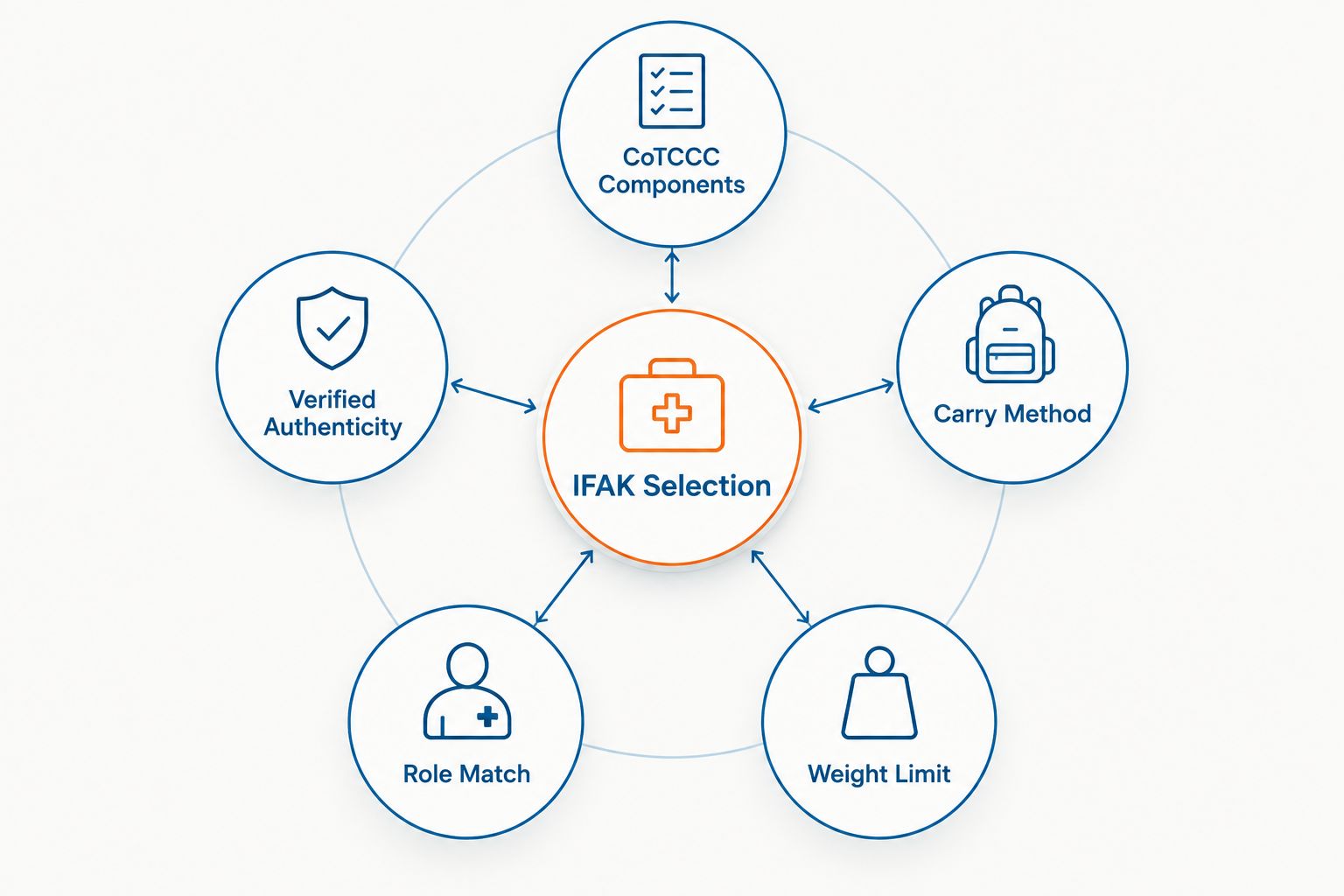
What makes the best IFAK kit for military use
- CoTCCC-aligned core components — tourniquet, hemostatic gauze, pressure dressing, chest seal, at minimum
- Verified authenticity — no counterfeit tourniquets or off-brand substitutes with unverifiable sourcing
- Carry method matched to load-bearing gear — MOLLE-mountable, ankle-mounted, or belt-worn depending on role
- Scaled to the wearer's actual job — individual self-aid is not the same kit as buddy-aid or medic-level care
- One-handed application under stress — components need to work when the wearer is the casualty
- Weight and bulk appropriate to the mission profile — a dismounted patrol carries differently than a vehicle crew
IFAK kits for military use in 2026: at a glance
| Kit type | Best for | Standout feature | Key limitation |
|---|---|---|---|
| Individual First Aid Kit (Gen 3-style) | Individual soldier or Marine on-body carry | Minimal footprint covering massive hemorrhage control | No airway adjunct or chest seal beyond the basic set |
| Advanced Medic-Level IFAK | Designated combat medics and corpsmen | Expanded hemostatic gauze and airway adjuncts for treating others | Bulkier footprint, requires trained application |
| Blow-Out Kit (BOK) | Dismounted light infantry on minimalist loadouts | Single-pouch, ultra-compact format | Single-casualty capacity only |
| Vehicle-Mounted Trauma Kit | Mechanized and motorized units | Higher-volume supply for multiple casualties | Not on-body; inaccessible if separated from the vehicle |
| K9 Tactical Trauma Kit | Military working dog handlers | Components configured for canine anatomy | Not a substitute for a human casualty kit |
| Civilian Bleeding Control Kit (military-derived) | Military families and reservists building home preparedness | Same hemorrhage-control logic in a civilian-legal format | Omits components restricted to trained or military use |
1. Individual First Aid Kit (Gen 3-style): best IFAK kit for individual carry
This is the baseline military IFAK — a compact pouch built for a single wearer's self-aid or buddy-aid, mounted on a plate carrier or war belt. It covers the core M.A.R.C.H. hemorrhage-control need with a C-A-T Tourniquet, hemostatic gauze, and a pressure dressing, without the bulk of a medic bag.
Individual First Aid Kit pros:
- Small enough to mount on nearly any load-bearing gear
- Covers massive hemorrhage, the most time-sensitive threat
- Standard across most conventional units, so training is consistent
Individual First Aid Kit cons:
- No airway adjunct or occlusive chest seal in most base configurations
- Not built for treating multiple casualties
Best for: individual soldiers and Marines carrying self-aid/buddy-aid gear on-body. Verdict: Buy.
2. Advanced Medic-Level IFAK: best IFAK kit for designated medics
This configuration adds volume — more hemostatic gauze, airway adjuncts, and often a chest seal — because a medic or corpsman is expected to treat someone other than themselves. It is heavier and takes more real estate on a kit, which is the trade-off for broader capability.
Advanced Medic-Level IFAK pros:
- Covers more of the M.A.R.C.H. sequence than a basic individual kit
- Built for treating a casualty other than the wearer
- Scales to the training level of a designated medic
Advanced Medic-Level IFAK cons:
- Heavier and bulkier than an individual IFAK
- Overkill for a rifleman who only needs self-aid capability
Best for: combat medics and corpsmen with formal trauma training. Verdict: Buy.
3. Blow-Out Kit (BOK): best IFAK kit for dismounted light infantry
A Blow-Out Kit strips the IFAK down to a single-pouch format — usually a tourniquet and a compressed hemostatic dressing — for units that need to shave weight on long dismounted movements. It sacrifices redundancy for speed and low bulk.
Blow-Out Kit pros:
- Lightest and smallest option on this list
- Fast to access under a plate carrier or chest rig
- Cheap to duplicate across a squad for redundancy
Blow-Out Kit cons:
- Single-casualty capacity with no backup components
- Not sufficient for anyone in a designated medic role
Best for: dismounted infantry prioritizing weight over redundancy. Verdict: Buy for its specific use case, skip as a primary IFAK.
4. Vehicle-Mounted Trauma Kit: best IFAK kit for mechanized units
This is a larger, multi-casualty kit stored in a vehicle rather than worn on the body — think a mounted patrol, a convoy vehicle, or a static team cache. It carries enough volume to treat more than one casualty, which an on-body IFAK cannot.
Vehicle-Mounted Trauma Kit pros:
- Multi-casualty supply volume
- No weight penalty on the individual wearing gear
- Practical for crew-served and mechanized units
Vehicle-Mounted Trauma Kit cons:
- Useless if personnel are separated from the vehicle
- Not a substitute for an individual on-body IFAK
Best for: mechanized and motorized units operating from a vehicle. Verdict: Buy as a supplement, not a replacement.
5. K9 Tactical Trauma Kit: best IFAK kit for military working dog handlers
A K9 trauma kit reconfigures the same hemorrhage-control logic — tourniquet-equivalent, hemostatic gauze, pressure wrap — for canine anatomy and sizing. It is a distinct category from a human IFAK, not a smaller version of one.
K9 Tactical Trauma Kit pros:
- Sized and configured for a working dog rather than a person
- Lets a handler address the same hemorrhage priorities in the field
- Fits standard K9 harness or handler kit setups
K9 Tactical Trauma Kit cons:
- Not usable for human casualty care
- A niche kit relevant only to handlers, not general-purpose units
Best for: military working dog handlers. Verdict: Buy if you handle a working dog, skip otherwise.
6. Civilian Bleeding Control Kit (military-derived design): best IFAK kit for military families
This configuration takes the same core hemorrhage-control logic used in military IFAKs and packages it for civilian legal use — useful for military families, reservists, and veterans building home or vehicle preparedness kits outside a unit's supply chain.
Civilian Bleeding Control Kit pros:
- Same hemorrhage-control priorities as a military IFAK
- Legal and appropriate for home, vehicle, or community use
- A logical starting point for reservists building personal preparedness
Civilian Bleeding Control Kit cons:
- Omits components restricted to trained or active-duty use
- Not a substitute for unit-issued gear on deployment
Best for: military families and reservists building home preparedness, not active deployment loadouts. Verdict: Buy for home use, skip as a deployment kit.
Why a genuine C-A-T Tourniquet matters in every IFAK
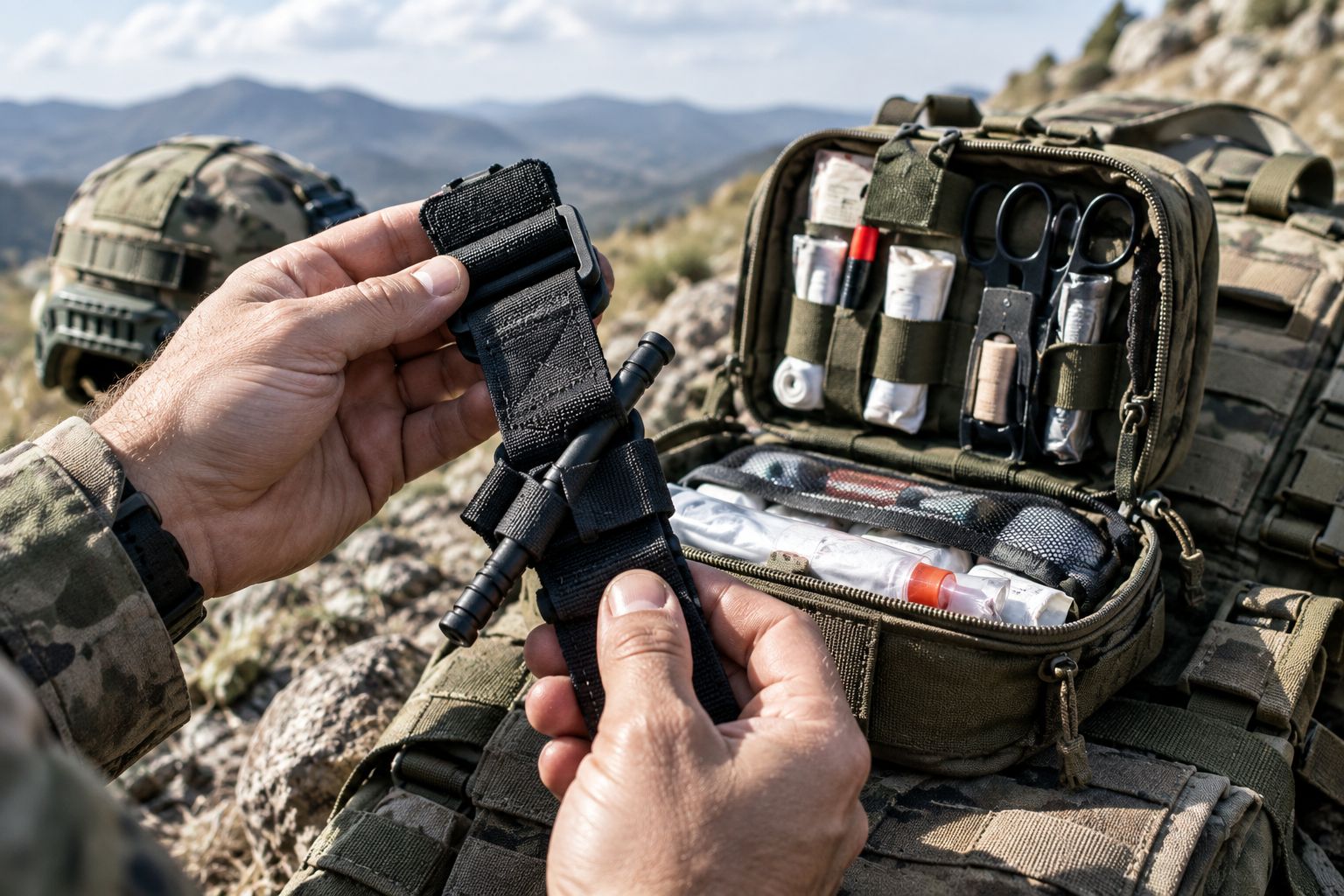
Counterfeit tourniquets have circulated through third-party online marketplaces for years, and tourniquet manufacturers and CoTCCC have publicly warned that copies are not built or tested to the same standard as genuine units. A kit is only as good as its weakest component, and a counterfeit tourniquet sitting in an otherwise well-built IFAK defeats the entire point of carrying one. Buy tourniquets through an authorized dealer with a verifiable sourcing chain, not a marketplace listing with no seller history.
How this list was ranked
Every kit above is scored against the same six criteria: CoTCCC-aligned components, verified authenticity, carry method, role match, one-handed application, and weight. No single configuration is rated universally best — the ranking matches each kit to the audience it is actually built for, which is why a rifleman's IFAK and a K9 handler's trauma kit sit side by side without competing for the same slot.
“No IFAK configuration is universally best — match the kit to the role, not the role to the kit.”
Which IFAK kit should you choose in 2026?
If you're an individual service member outfitting your own kit, start with the Individual First Aid Kit (Gen 3-style) — it covers massive hemorrhage control in the smallest usable footprint. Medics and corpsmen need the Advanced Medic-Level IFAK for its expanded capability. Vehicle crews, K9 handlers, and military families should each pick the configuration built for their specific role rather than defaulting to whatever kit is easiest to find in 2026.
Source verified IFAK components
Browse genuine tourniquets and trauma supplies with a verifiable sourcing chain.
FAQ
What's the best IFAK kit for military use in 2026?
It depends on the role: the Individual First Aid Kit (Gen 3-style) is best for individual on-body carry, while an Advanced Medic-Level IFAK is best for designated medics and corpsmen. There is no single kit that serves every role equally well in 2026.
Is a Blow-Out Kit better than a full IFAK for dismounted patrols?
A Blow-Out Kit is lighter and faster to access, which suits dismounted infantry prioritizing weight over redundancy. It carries less capacity than a full IFAK, so it's a trade-off rather than a straight upgrade.
How can you tell if a C-A-T Tourniquet is genuine or counterfeit?
Buy only through an authorized dealer with a verifiable sourcing chain, and inspect the windlass, buckle, and stitching on receipt. Manufacturers and CoTCCC have warned that counterfeit units are not built to the same standard as genuine ones.
Do medics need a different IFAK than infantry?
Yes. Infantry typically carry an Individual First Aid Kit built for self-aid and buddy-aid, while medics and corpsmen carry an Advanced Medic-Level IFAK with expanded hemostatic gauze and airway adjuncts for treating others.
What's the difference between an IFAK and a vehicle trauma kit?
An IFAK is worn on the body and sized for one or two casualties, while a vehicle-mounted trauma kit is larger and stored in the vehicle to cover multiple casualties. They serve different roles and one doesn't replace the other.
Can civilians buy a military-style bleeding control kit?
Yes, civilian bleeding control kits use the same hemorrhage-control logic as military IFAKs but omit components restricted to trained or active-duty use. They're a reasonable choice for military families and reservists building home preparedness.
How much does an IFAK weigh?
Weight varies by configuration — a Blow-Out Kit is the lightest option on this list, while an Advanced Medic-Level IFAK is the heaviest because it carries more components for treating others.
What should be in a K9 tactical trauma kit?
A K9 trauma kit follows the same hemorrhage-control priorities as a human IFAK but with components sized and configured for canine anatomy. It's a distinct category built specifically for working dog handlers, not a scaled-down human kit.
One last thing
The single most common failure point in fielded IFAKs isn't the contents list — it's a tourniquet that's been sitting in a pouch since issue with no one checking it for wear, expiration, or authenticity. Whatever configuration you land on for 2026, inspect it at least twice a year regardless of kit type; a kit that's never been opened since issue day is a liability, not a safety net.